
Mutual Trust is Built Not by Words but by Works!
Since 2017, I have been assigned as a Member of the International Selection Committee for Florence biennale. Accepting this role has been for me, more than just that. As an observant artist and conscious person, who always seek seeing the full picture of matters to reason, balance, improve decision-making rather than just providing automated responses but deliberate awareness, I found myself not simply fulfilling the assigned duties but also contributing beyond formal expectations because of a personal sense of responsibility and awareness. Thus, I’ve naturally, provided suggestions, practical and useful guidelines to both parties, Florence biennale and participants Artists.
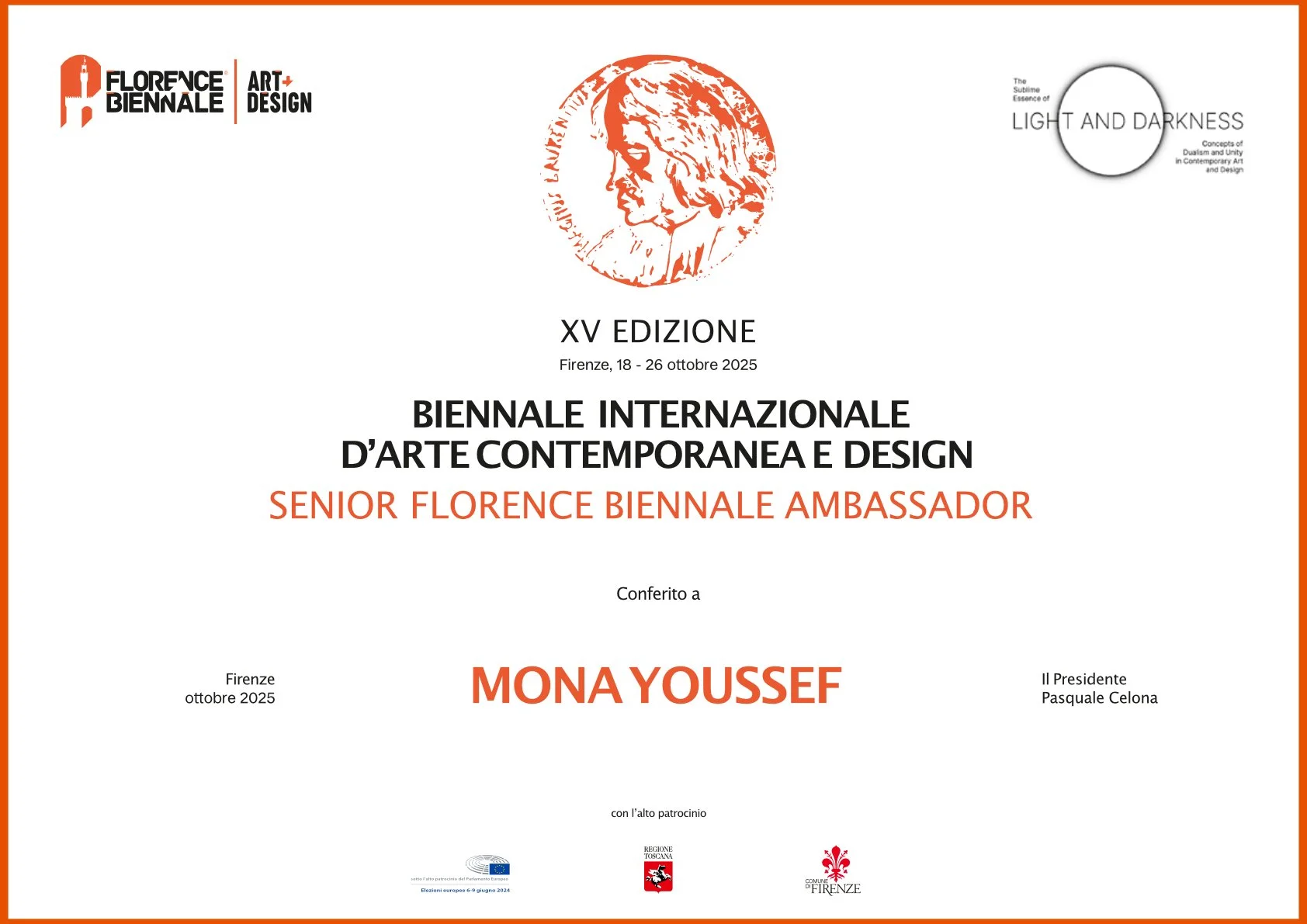
This biological consciousness of mine led to be assigned, by Florence Biennale, as an Advisor then as Ambassador, then as a Senior Ambassador.
Being conscious in what we do, can at times be costly, because we choose to do more than what is expected of us, not to please anyone but to do what we believe is rightful. Acting with awareness and integrity often requires more effort, more patience, and sometimes accepting misunderstandings or lack of recognition. Yet those actions tend to build deeper forms of credibility because they are demonstrated consistently rather than performed for appearance. How true that awareness combined with truthful introspection can shape character.
Looking deeper into what Consciousness is; It is linked to the organized, energetic activity of the brain. It’s evolved to enhance survival, enabling complex behaviors like anticipation, planning, and symbolic communication (language), rather than just reacting to stimuli. Some researchers argue that consciousness is closely linked to social perception and the development of a "self-model" for navigating group dynamics. Other research suggests that consciousness is rooted in the electromagnetic (EM) fields produced by neurons and glia (brain cells), which represent the physical manifestation of computations. Consciousness is widely considered an emergent property of neural processing—a "behavior" of the brain rather than a single location. There is also evidence that Brainstem and Thalamus are the ancient structures to regulate stimulation, wakefulness, and awareness, acting as a gate for consciousness. It Is believed that biological consciousness refers to the subjective, internal experience of being—awareness of self, environment, and mental processes—arising from physical, biological processes in living organisms. Unquestionably, biological consciousness in humans is primarily caused by complex, integrated activity within the physical brain, resulting from the interaction of roughly 86 billion neurons and their synaptic connections.
That said, consciousness remains one of the most unresolved subjects in science and philosophy. Neuroscience can increasingly identify correlations between brain activity and conscious states, but explaining why subjective experience exists at all—the “inner feeling” of being—is still an open question. The biological mechanisms may describe how consciousness functions, while philosophy continues to wrestle with why subjective experience emerges from matter in the first place.
While this intriguing and endless subject of the brain is not my professional field yet, it has been always of great interest to learn about. Learning about how we function, why we behave in certain ways or say certain things and carefully examine our motives for improvements is a way of life to enjoy quality life, to build trust not by words but by works.
What are your thoughts? I would love to read them.
©Mona Youssef